
2026 Modern Curing Lights Guide

one second curing light

Modern Light Curing: Physics, Photochemistry, and Diagnostic Innovation

This 2026 Modern Curing Lights Guide explores how broadband LEDs prevent composite failures and boost clinic ROI.

Photopolymerization is one of the most frequently performed procedures in modern restorative dentistry. From direct composite restorations and orthodontic bracket bonding to indirect ceramic luting, the clinical longevity of resin-based materials hinges almost entirely on the quality of light curing. Yet, despite its daily frequency, light curing is often treated as a passive, push-button task.

Inadequate polymerization remains a leading cause of premature composite failure, microleakage, post-operative sensitivity, secondary caries, and color instability. Understanding the optical physics, photochemical reactions, and hardware engineering that govern light curing allows clinicians to consistently achieve complete resin conversion while optimizing chairside efficiency.

Beyond the Bulb: The Technological Leap from Halogen to Solid-State LED

For over two decades, Quartz Tungsten Halogen (QTH) units were the undisputed standard for light-curing units (LCUs) in dental operatories. Understanding why QTH technology was systematically replaced by solid-state Light Emitting Diodes (LEDs) illustrates how optical efficiency directly dictates clinical outcomes.
This vaporization results in the release of significant amounts of electromagnetic energy, predominantly in the infrared spectral region, where the heat required for the curing process is generated. Consequently, these types of light units typically necessitate substantial cooling mechanisms to dissipate the generated heat, along with excess visible light that is not essential for the photocuring process.

The Inefficiencies of Quartz Tungsten Halogen (QTH)

QTH lights function by passing an electric current through a tungsten filament enclosed in a halogen gas capsule. The filament glows at extreme temperatures, producing light across a massive spectral band ranging from ultraviolet through the visible spectrum and deep into the thermal infrared (IR) zone.

Because dental photoinitiators only absorb light within specific blue wavelengths, QTH systems require internal bandpass optical filters to strip away hazardous UV and thermal IR radiation. Over 95% of the total electrical energy consumed by a QTH light is wasted as heat. Furthermore, the constant thermal cycling degrades the optical filters and tungsten filament, leading to a steady drop in light output intensity long before the bulb burns out completely.

The Solid-State Advantage of LED Emission

Light Emitting Diodes operate through semiconductor electroluminescence. When a current passes through a P-N junction, electrons recombine with electron holes, releasing energy as photons within a tightly controlled wavelength band.

Targeted Spectral Efficiency: LEDs convert electrical energy directly into light within the exact absorption spectrum required by dental photoinitiators, eliminating wasted infrared energy.
Filter-Free Optical Paths: Solid-state diodes emit light without optical bandpass filters that crack, degrade, or diminish over time.
Instantaneous Peak Power: LEDs reach maximum irradiance in milliseconds without warm-up delays or spectral output shifting.
Extended Service Life: Modern high-power LEDs deliver over 10,000 hours of continuous operational life without significant irradiance decay.

Semiconductor Physics: How Diodes Convert Electricity into Photons

To understand why modern LED curing lights are so compact and powerful, one must look at the quantum mechanics of semiconductor diodes. Unlike incandescent filaments that glow when heated, LEDs generate cold light via bandgap energy emission.

LED light-curing devices emit light in the blue segment of the visible spectrum, typically falling between 440 and 490 nm, and do not produce heat. These units can be powered by rechargeable batteries due to their low wattage requirements, and they operate more quietly than QTH units as they eliminate the need for a cooling fan. In their initial versions, LED units emitted light with lower intensity, but newer iterations incorporate multiple LEDs with varying wavelength ranges. This enhances the spectrum of emitted light and boosts overall intensity to effectively polymerize all dental materials activated by visible light.


Certain pencil-shaped curing light models utilize metal body casings, providing not only structural durability but also a substantial area for effective thermal dissipation.

The Photochemical Chain Reaction: Converting Liquid Monomers to Solid Polymers

Light curing is a multi-step photochemical polymerization process. The light emitted from an LCU serves as a precision catalyst, triggering a radical addition polymerization reaction that converts liquid monomer resin matrices into a cross-linked polymer network.

Dental composite materials activated by visible light include an initiator, such as camphorquinone (CQ), which absorbs light at the specific wavelength of approximately 470 nm for CQ. When this initiator combines with an organic amine like dimethylaminoethyl methacrylate (DMAEMA), the ensuing reaction generates free radicals necessary for initiating polymerization.
To eliminate the yellow tint associated with CQ, resin manufacturers frequently incorporate alternative photoinitiators like TPO (Lucirin TPO) or Ivocerin. These alternative initiators require violet wavelengths in the 385–410 nm range, which is why modern broadband (polywave) LED curing lights incorporate both blue and violet LED chips.

The number of photons absorbed by the initiator, crucial for optimal polymerization, depends on the wavelength, intensity, and duration of light exposure. Importantly, variables such as the intensity of the light-curing unit, angle of illumination, tip diameter of the light source, distance from the light source, and exposure duration can significantly influence the formation of free radicals. Consequently, this system is highly sensitive to technique.

Furthermore, manufacturers of composite filling materials employ initiators different from CQ in visible light-activated substances. Since these initiators absorb light at wavelengths distinct from CQ, it is imperative that the light-curing unit emits light at the required wavelength for the specific initiator used.

2026 Modern Curing Lights Guide: Implications of LED Curing Lights Power

Modern light-curing units boast higher intensities, typically surpassing 1000 mW/cm2. This elevated intensity allows either shorter curing durations at a specific depth or greater depth of cure for a given curing period.
However, it’s essential to note that using these high-intensity lights may increase shrinkage stresses within the restoration.
It’s crucial to bear in mind that the type of light-curing unit and the chosen curing mode significantly influence polymerization kinetics, shrinkage, and associated stresses. These factors also impact microhardness, depth of cure, degree of conversion, color change, and microleakage in visible-light-activated restorations.
Ensuring the safety of patients and clinic personnel when utilizing dental light-curing units is paramount, necessitating precautions such as protective eyewear and light shields.

Uncollimated curing lights diffuse rapidly, losing over 50% of their effective energy at an 8 mm working distance. If a clinician uses a standard 10-second cycle at an 8 mm gap with a divergent light beam, the resin at the floor of the cavity box receives insufficient light energy, resulting in soft resin and marginal failure.

Variations in the depth of light penetration, curing light intensity, tip diameter of the light source, and exposure time can lead to differences in polymerization.
Light-activated resin composites offer advantages such as ease of manipulation, control of polymerization, and the absence of the need for mixing. The absence of mixing in light-activated composites reduces the likelihood of incorporating air and forming voids in the mixture.

The Impact of Distance on Energy Delivery

In clinical operatories, curing light tips are rarely placed flat against the resin surface. When curing deep Class II proximal boxes, endodontic post spaces, or cavity floors, the distance between the light tip and the composite can easily exceed 6 mm to 8 mm.

Light follows the Inverse-Square Law: light intensity drops rapidly as distance from the source increases.

The intensity of light at the surface plays a crucial role in achieving a thorough cure both at the surface and within the material. We strongly recommend keeping the tip of the light source within 1 mm of the surface for optimal exposure.

Most dental curing lights typically have a standard exposure time of 20 seconds, generally adequate to cure a light shade of resin to a depth of 2 or 2.5 mm, assuming the light guide is in immediate proximity to the restoration surface.

However, the tooth’s anatomy often prevents placing the light guide close to the restoration surface.
It’s important to note that the light beam is partially collimated and doesn’t spread sufficiently beyond the diameter of the tip at the emitting surface. Consequently, it becomes necessary to “step” the light across the surface of large restorations to ensure complete exposure across the entire surface.
As we have already discussed in our 2026 Modern Curing Lights Guide, recent advancements have significantly improved the electrical supply to dental LEDs.
Notably, the progress in lithium polymer battery technology has resulted in lighter and more durable power supplies. Additionally, the introduction of a dental light-curing unit completely devoid of batteries, operating through the charging and discharging of an “ultra-capacitor,” has substantially extended the lifespan of dental curing lights.

2026 Modern Curing Lights Guide: Understanding Collimation and Homogeneity

Advanced curing lights solve distance-related light loss using two optical strategies:

  • Collimated Beam Alignment: Parallel optical lenses prevent light divergence, delivering a tight column of photons that maintains consistent energy intensity whether at 1 mm or 8 mm distance.

  • Beam Homogeneity: The light spot must deliver a uniform energy profile across the entire tip diameter. Cheap LED chips often contain “hot spots” in the center and “dead zones” around the edges, causing uneven curing across the restoration surface.

2026 Modern Curing Lights Guide: Transillumination, Caries Detection, and Ultra-Fast Curing

The dental curing light has evolved from a single-purpose curing lamp into a multi-mode diagnostic platform. Modern clinics demand versatile handpieces that combine ultra-fast polymerization with advanced optical diagnostics.

One Second Curing: Maximum Chairside Efficiency

The transition to high-intensity broad-spectrum LEDs has made 1-second curing a reality. By delivering focused power outputs up to 2,400–3,000 $\text{mW/cm}^2$, these units deliver the total required energy dose in a 1-second pulse. This capability transforms high-volume restorative workflows, pediatric dentistry, and orthodontic bracket placement.

Diagnostic Optical Transillumination & Fluorescence

By incorporating specialized short-wavelength violet and UV diodes ($385–410\text{ nm}$), modern curing lights function as diagnostic instruments. Decayed enamel, bacterial porphyrins, plaque, and cracked tooth structures fluoresce under specific light wavelengths, revealing hidden pathology without ionizing X-ray radiation.

Key Features and Clinical Advantages:

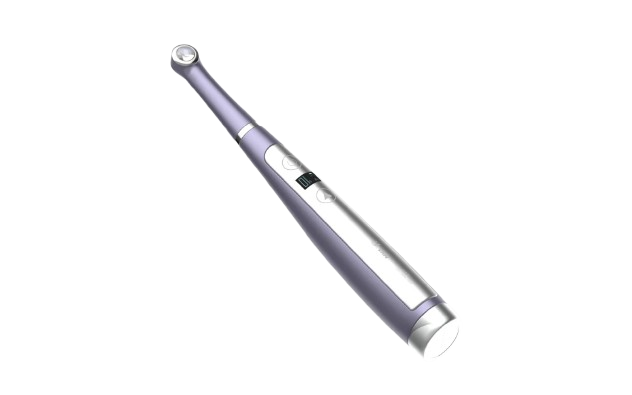
  • Dual-Function Diagnostic and Curing Unit: Operates as both a high-power polymerization light and a diagnostic fluorescence device, streamlining chairside equipment needs.

  • 1-Second Polymerization Power: High irradiance options output energy up to $2,400\text{ mW/cm}^2$, enabling complete 1-second curing for standard composite layers, reducing procedure times.

  • Broad-Spectrum Wavelength Coverage (385nm – 515nm): Emits across both violet and blue light spectra, ensuring full compatibility with traditional Camphorquinone (CQ) and modern alternative photoinitiators (TPO, Ivocerin).

  • Integrated Fluorescence Caries Detection Mode: Utilizes targeted light radiation to excite porphyrins in carious lesions, dental plaque, and micro-cracks. Under the diagnostic beam, decayed tissue fluoresces red/orange while healthy enamel remains dark, enabling clear visualization of carious dentin during cavity preparation.

  • Smart Constant-Intensity Drive Circuit: Incorporates voltage regulation to ensure light output remains steady as the battery drains, protecting against partial curing.

  • High-Capacity Battery & Ergonomic Housing: Designed for high-volume use, providing over 400 curing cycles per full charge, packaged in a lightweight, ergonomic housing that minimizes hand strain.

Conclusion: Elevating Clinical Standards Through Optical Precision

Light curing is a fundamental step in modern adhesive dentistry. Transitioning from legacy halogen units to high-power, broad-spectrum LED systems ensures complete degree of conversion, maximum bond strength, and long-term restoration durability.

By understanding the physics of light transmission, maintaining proper working distances, and using advanced multi-mode devices—like our One Second Light with Caries Detection—clinicians can optimize chairside speed while elevating diagnostic accuracy for every patient.

Your Shopping Cart0
There are no products in the cart!
Continue shopping
0